Jul 3, 2026
Michelle Wie West Comeback Case Study: Building a Consistent Swing with Data


When Michelle Wie West announced her return to competitive golf for the historic 2026 U.S. Women’s Open at Riviera Country Club and the tech-forward WTGL circuit, the golf world took notice. As a former prodigy who captured the 2014 U.S. Women’s Open title before stepping back to focus on family, venture investing, and recovering from chronic wrist injuries, her return meant one thing: she wasn’t just showing up for a victory lap. She wanted to compete at the highest level.
However, preparing for major championship conditions while balancing motherhood and a full career meant she no longer had the luxury of spending 10 hours a day on the practice tee. To gear up efficiently, Wie West turned to a tool she had championed as an early investor and board member: Sportsbox 3D Golf.
The Shift: From Hitting More Balls to Getting Better Feedback
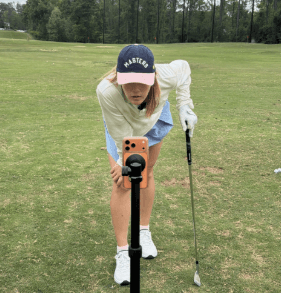
Earlier in her career, Michelle Wie West was known for putting in enormous hours on the range, hitting ball after ball while trying to internalize complicated swing changes. Today, her approach is almost the opposite: do less guessing, get better feedback, and make every rep count.
“This is the most consistent my swing has been without having to hit a ton of balls,” Wie West explained. “I used to waste so much time on the range—beating a lot of balls and chasing different feels every single day. Now, I can see what my body is actually doing instantly.”
The difference isn’t that she stopped working on her swing. It’s that she changed the feedback loop.
Instead of judging every rep primarily by ball flight or by how a swing felt, Wie West could measure the movement she was actually trying to change. That meant fewer wasted reps, less searching for a new feel after every bad shot, and significantly less wear and tear on her body.
Finding the Movement Behind the Miss
At first glance, there wasn’t an obvious problem.
On conventional 2D video, Wie West’s backswing looked fundamentally sound. But she was still experiencing inconsistent contact and losing some of the compression she wanted with her irons.
The goal wasn’t to search the swing for faults. It was to answer a much narrower question:
What was different in her movement when she wasn’t striking it the way she wanted?
Using markerless 3D analysis from ordinary smartphone video gave Wie West and her team another layer of information. One movement pattern stood out: the timing of her pelvis sway in the backswing.
Her pelvis was moving toward the trail side later than they wanted.
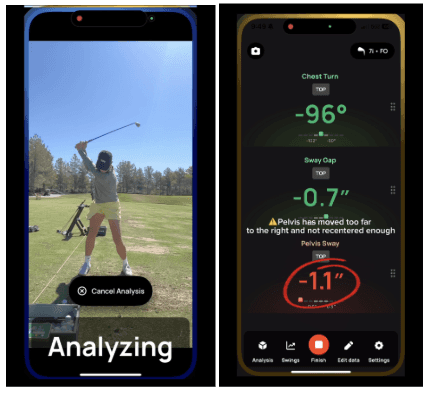
What you could see | What the movement data added |
|---|---|
Backswing appeared smooth | Pelvis sway was occurring later in the backswing |
Plenty of turn at the top | The lower body wasn’t establishing the desired position early enough |
Arm and club positions looked reasonable | The timing difference affected how the rest of the motion had to organize in transition |
Why the Timing of Sway Matters
“Sway” can sound like something golfers are supposed to eliminate. In reality, lateral movement of the pelvis is a normal part of a golf swing.
The more useful question is how much, in which direction, and when?
For Wie West, the issue wasn’t simply whether her pelvis moved toward the trail side. It was the timing of that movement. Her team wanted that motion established earlier in the backswing so the rest of her sequence had more time to organize naturally.
That distinction is difficult to manage through feel alone.
A player might think, I need to move more right, when the actual goal is not necessarily more movement—it may simply be the same movement earlier.
That’s where having a number changes the practice process.
Turning a Swing Feel Into a Measurable Goal

Once Wie West knew which movement she wanted to change, she no longer needed to think about her entire swing.
She had one job.
Using real-time 3D feedback, she could establish a target for the pelvis movement she and her team wanted and then practice against that number.
The process became simple:
Make a swing → measure the movement → get immediate feedback → adjust → repeat.
Rather than hitting ten balls, looking at the flight, changing her feel and trying another ten, she could isolate the movement itself.
If she was working on getting her pelvis moving earlier, then that became the success criteria for the rep—even if the ball happened to fly poorly.
That is an important distinction.
When golfers make a swing change, they often abandon the correct movement because one or two shots produce a bad result. But ball flight contains a lot of variables. If the goal is to change a particular body movement, the most useful feedback is whether that movement actually changed.
With her phone on a tripod, Wie West could see that feedback immediately and calibrate the feel required to produce the movement she wanted.
Over time, the number teaches the feel.
Eventually, she doesn’t need to think about the number at all.
Fewer Reps. More Intent.
The result was a very different kind of practice.
Old feedback loop | New feedback loop |
|---|---|
Hit a lot of balls | Hit purposeful reps |
Judge the swing primarily by ball flight | Measure the movement being trained |
Chase a different feel when shots go poorly | Stay committed to a defined movement goal |
Hope the swing change is happening | Know whether the movement is changing |
High practice volume | Higher-quality practice with fewer reps |
For Wie West, that efficiency also mattered physically.
After years of professional golf and significant wrist issues, hitting hundreds of unnecessary balls carries a real cost. A practice system that allows her to confirm a movement change in fewer swings isn’t simply more convenient—it makes continued high-level practice more sustainable.
A Better Feedback Loop
The biggest lesson from Wie West’s approach isn’t that every golfer needs to become obsessed with biomechanics.
It’s almost the opposite.
Good data should make the swing simpler.
Measure the swing to establish a baseline. Identify the one or two movements that matter most. Set a clear goal. Then give the player immediate feedback while they practice.
Instead of trying to feel whether a change happened—or waiting for ball flight to tell you—the player knows.
That’s the shift Wie West has made.
She isn’t practicing less because the swing matters less. She can practice less because each swing gives her better information.
And for golfers who have spent years beating balls hoping the next bucket will finally make a swing change stick, that may be the biggest advantage of measurement:
You don’t need more reps. You need better feedback on the reps that matter.